
The Form Will Change. Design Will Remain.
A Vedantic reflection on AI, and the future of design

The most useful thing I read about the future of design was not a trend report, an AI thread, or a product launch.
It was the first shloka of the Īśāvāsya Upaniṣad.
ईशावास्यमिदं सर्वं यत्किञ्च जगत्यां जगत्।
तेन त्यक्तेन भुञ्जीथा मा गृधः कस्यस्विद्धनम्॥
Īśāvāsyam idaṁ sarvaṁ yat kiñca jagatyāṁ jagat
Tena tyaktena bhuñjīthā mā gṛdhaḥ kasya svid dhanam
Everything that appears in this changing world is pervaded by Īśa, the Divine reality. Therefore, live in the world with renunciation. Do not cling to anything as “mine,” because nothing truly belongs to the individual ego.
To be honest, I was not reading this shloka to understand design. But one idea stayed with me.
Everything that appears in this changing world is pervaded by Īśa, the Divine reality.
If everything is pervaded by the same reality, why do we experience the world as different? We do not wake up and see one undivided reality. We see a world broken into names and forms: a room, a tree, a laptop.
I do not think I have answer to that question in this article. Perhaps it needs realisation.
Strangely, this question brought me back to Design.
Isn’t design also about names and forms?
A chair is not just material. Through design, it becomes a way of sitting, resting, waiting, gathering, or working.
A logo is not just shape and colour. Through design, it becomes memory, identity, recognition, and trust.
An app is not just screens. Through design, it becomes a path, a behaviour, and an experience.
Design gives name, form, structure, and meaning to things that makes life easier.
From the earliest tools shaped by human hands to the complex systems we use today, design has always been present in human evolution. Every man-made object carries an intention to solve a problem, improve a condition, create meaning, or make life a little better. The forms have changed (a simple hunting tool to a sophisticated drone) across centuries, but the impulse behind them has remained remarkably consistent. That enduring impulse to improve, adapt, and shape human experience is what I call Design (with a capital “D”), because Design (not design) is present every time we solve a problem..
Now, everywhere online, people are saying design is dying. The argument is familiar now: AI can generate logos, images, layouts, interfaces, websites, videos, and product concepts. If machines can generate the output, what happens to the designer?

The fear is understandable.
But maybe the fear comes from confusing design with Design.
“design” is the professional form i.e. the output we recognise today: logos, interfaces, products, services, portfolios, tools, job titles, and design schools. “Design” is older and deeper. It is the human impulse to solve, improve, adapt, and shape experience.
New technologies and new means of production have brought new kinds of problems, and each time the human impulse to improve, adapt, and shape experience responds to them. What changes are the forms through which Design is expressed.
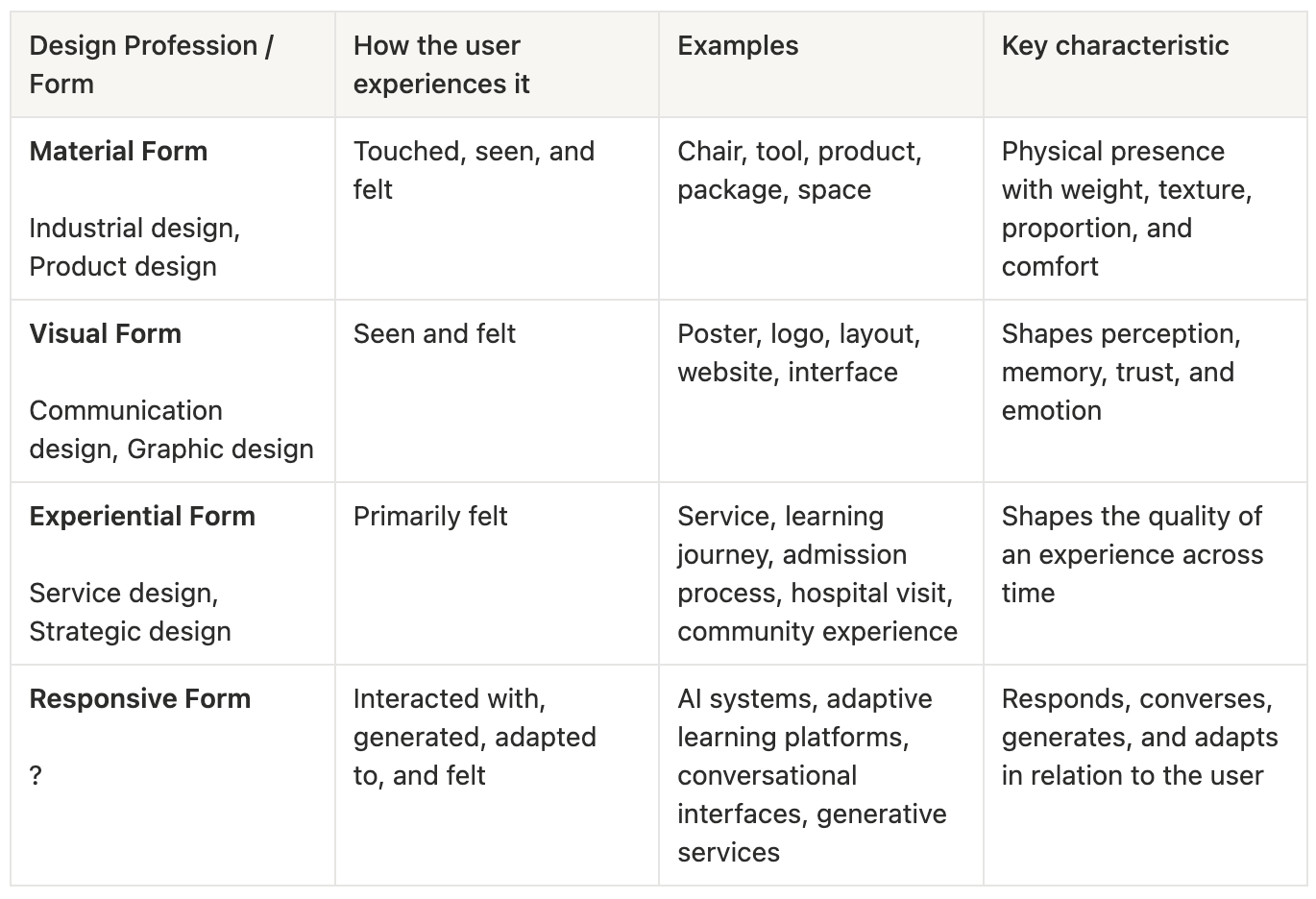
Design, the impulse to make life better, has been intrinsic to all these forms.
The new in the age of AI is not the disappearance of earlier forms, but the emergence of this Responsive Form, where the designed thing is no longer entirely fixed before the user arrives. It can respond in the moment, generating different outcomes for different users and contexts.
For example: Even though the initial interface of ChatGPT is the same for everyone, once a user begins interacting with it, the experience becomes highly personal. The interaction unfolds through conversation, adapting to different questions, goals, contexts, and desired outcomes for each user.
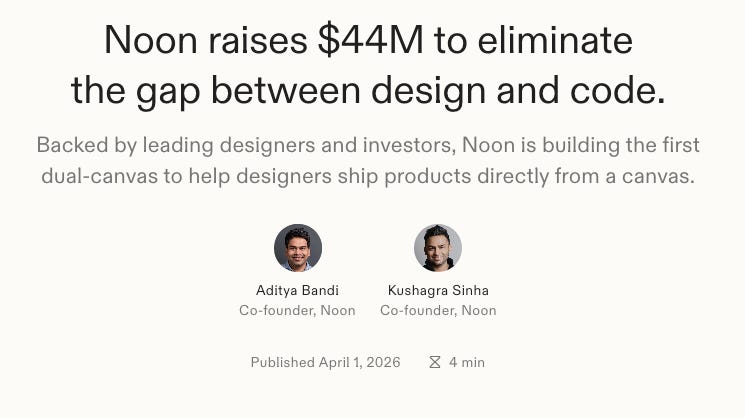
We can already see this shift inside design tools themselves. Noon.design describes itself as a product design tool that works directly on product code, allowing designers to explore, design, build, test, and ship from the same canvas. What is important here is not only the AI feature. It is the shift in what a design artefact is. Product design is no longer treated only as a flat picture of a future product. The designed thing is closer to the thing that can move, respond, evolve, and ship.
And that’s the case with almost all the tools and websites on the internet. They are no longer simply software with predefined outputs. They respond to prompts, context, and user intent, producing different results for different people.
The designer is no longer designing only a fixed object, screen, or journey. The designer is shaping the conditions, rules, behaviours, and boundaries within which new experiences can emerge. That shift, from designing a predetermined form to designing a responsive one, is what feels genuinely new.
AI simply adds another form. The form that is still taking shape. AI is only disturbing our attachment to our familiar form of design. Hence the chaos.
So, what should a Designer do?
This brought me to the second line of the shloka.
तेन त्यक्तेन भुञ्जीथा मा गृधः कस्यस्विद्धनम्।
Tena tyaktena bhuñjīthā mā gṛdhaḥ kasya svid dhanam
Live in the world with renunciation. Do not cling. Do not covet. Nothing truly belongs to the individual ego.
Don’t worry it is not telling to leave design. Here “renunciation” means not clinging to one form of design. Do not cling to one title or output or tool: industrial designer, communication designer, UX designer, service designer, AI designer.
These forms are useful. They help Design become visible, usable, and understandable. But they are still forms. They are not Design itself.
The Designer who understands the principle behind form will move with change.
This is also where I feel design education has to evolve.
For a long time, design education has been organised around outputs and departments: product, communication, fashion, interiors, interaction, animation, UX.
These divisions are not wrong. They are useful.
But if students start believing that their stream is their final identity, they become fragile. Not because they are weak, but because they have been taught to cling to one way of creating. The renunciation the shloka speaks of is not about leaving design. It is about not gripping it so tightly that you cannot move when the form does.
A student entering design today cannot only be trained to make one kind of output. They need to understand how Design appears across material, visual, experiential, and responsive forms. Most importantly, they need to understand that Design is not dying every time a new technology appears.
The teacher's job, then, is not just to teach the current form. It is to help students fall in love with the principle behind all forms. That love will travel with them wherever design goes next.
While thinking and writing this piece, it came to my mind whether I am forcing Upanishadic teachings onto Design. But the fact is they point toward direct truths about reality, perception, change, attachment, identity, and freedom. That is why these insights can be seen at many levels: in the macro and the micro, in spiritual life and professional life, in belief and even in disbelief.
The question is not whether design and Vedanta are the same. They are not.
The question is whether a Vedantic way of seeing can help a designer see Design more clearly. For me, this shloka made the current anxiety around AI feel less frightening. Īśāvāsyam idaṁ sarvaṁ: everything is pervaded by the same divine reality.
So when the next tool comes, the next interface comes, the next AI system comes, or the next design title comes, maybe we do not have to panic immediately.
Maybe we can pause and ask: What is changing? And what is the principle that remains? You will notice:
The Form will Change. Design will remain.
Please note: this article is a personal memo based on the experiences, questions, and learnings I have had over the last few months. Feel free to comment, disagree, or add your perspective. And, yes, don’t forget to like this article if this was helpful.
Loved reading this piece thoroughly, the analogy of upanishads & design is very well put.
I also like to read anything related to design in old Indian texts, I also come up with thought way back in graduation that By practicing and understanding design, creativity exists beyond time. Innovation improves what already exists, but creativity creates a new way of seeing, thinking. Repeating old styles preserves a legacy, while true creativity breaks existing patterns and introduces new ones, creativity is not merely an improvement of the old, it is the emergence of something previously unimagined, an idea powerful enough to redefine the zeitgeist of its time.